
Three by Jerzy Skolimowski
EO (2022), The Shout (1978), and Deep End (1970)

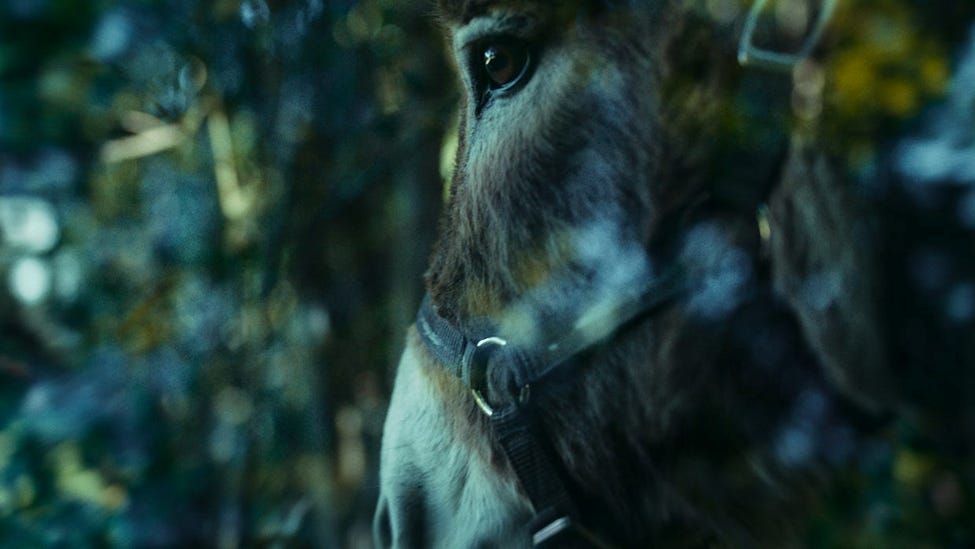
On a whim, I recently revisited Jerzy Skolimowski’s EO, the Polish filmmaker’s contemporary riff on Au Hasard Balthazar, from 2022. A film that cracked a good number of that year’s best-of lists, I didn’t love EO to the extent that some did, but I was intrigued by Skolomowski’s vividly experimental approach to the picaresque tradition.
My re-watch was at home via The Criterion Channel, and my reaction to the film didn’t change much. On purely formal terms, the movie can be exhilarating: those out-of-nowhere, soaring landscape shots, filtered through a hallucinatory, searing shade of red, grabbed my attention yet again. The editing is also bracing: see the abrupt cut from EO’s adoring human circus companion to a giant mechanical claw at a garbage dump, or the transition from EO’s terrible beating by soccer hooligans to the flummoxing image of a small, four-legged robot crawling around the ground. One way the film repeatedly de-sentimentalizes its donkey hero’s journey is by making its narrative turns rather mystifying at first glance. Just as our emotion starts to build towards EO and his soulful, innocent eyes, our focus is abruptly re-routed into a new context. I enjoy the disorientation, even if I’m not sure the film comes together perfectly on the whole.
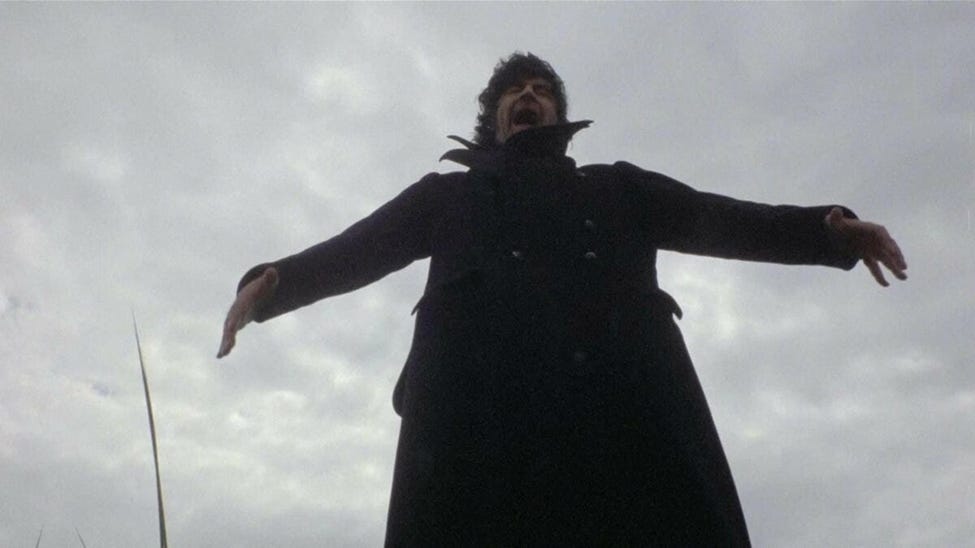
Turns out, disorientation is the name of this filmmaker’s game, at least based on the couple of other films I sought out after revisiting EO. 1978’s The Shout is a take on rural British horror, where intimations of supernatural menace coincide with a portrait of a marital dysfunction. The film centers on a couple, Anthony and Rachel (John Hurt and Susannah York) whose relationship is unsettled by the arrival of Alan Bates’ mysterious wanderer, Crossley. A messy, unsettling love triangle takes shape after Crossley claims he possesses deadly powers, but the truth of what’s seen is put into question by a framing device, where Crossley, now in a mental institution alongside Anthony, relates the film’s events. Before it finally devolves into a memorable climax of utter hysteria and confusion (this involves Jim Broadbent ripping his clothes off in a rainstorm, for what that’s worth), The Shout’s fragmentary editing and psycho-sexual ambiguity brings the work of Nic Roeg to mind. It’s unsurprising to learn he was originally tapped to direct the film.
For all their differences, what EO and The Shout have in common is an ability to knock you off stable footing. These are films of startling shifts, images, and sounds that continuously destabilize. This tendency of Skolomowski’s is even more pronounced and thrilling in the masterful anti-coming-of-age Deep End, from 1970.
Deep End blew me away, and it led me to wondering about Skolomowski’s relatively obscure position in world cinema. Despite a filmography of over twenty films running back to the early ‘60s and the flash of attention that came with EO’s warm critical reception, my sense is that Skolimowski is an auteur without too many vocally ardent proponents. That’s probably due in part to the inaccessibility of his work, along with the fact that he doesn’t easily fit within a national cinema: after cutting his teeth within the Polish film world, he made a number of English-language films in the UK as well as the US. If there’s a single film that suggests he’s deserving of more extensive investigation, it is undoubtedly Deep End.
An astonishing, unpredictable vision of male adolescence, Deep End play outs mostly within a London bathhouse, where baby-faced teenager Mike (John Moulder-Brown) gets a job and falls hard for his slightly older co-worker, Susan (Jane Asher, so good). Despite learning that Susan is engaged, Mike becomes fixated on her, and in between their attending to bath-house patrons, she is fitfully receptive to his interest. Tracing their push-and-pull of a relationship through a thrillingly mobile camera, Skolimowski charts a kinetic, tonally slippery portrait of romantic obsession carried to a grim end point.
The film’s mood is ever shifting, and difficult to pin down. The first images of Mike – riding his bike through London to a Cat Stevens song – suggest the fuzzy warmth of an early ‘70s charmer about boyhood innocence. But as Mike makes hare-brained attempts to become intimate with Susan, the film conveys an unsettling strangeness. This is more than aided by Skolimowski’s visual style, which features vibrant pops of color, like that of Susan’s taxi cab-yellow rain slicker, and camerawork that disorients through its nimble maneuvers.
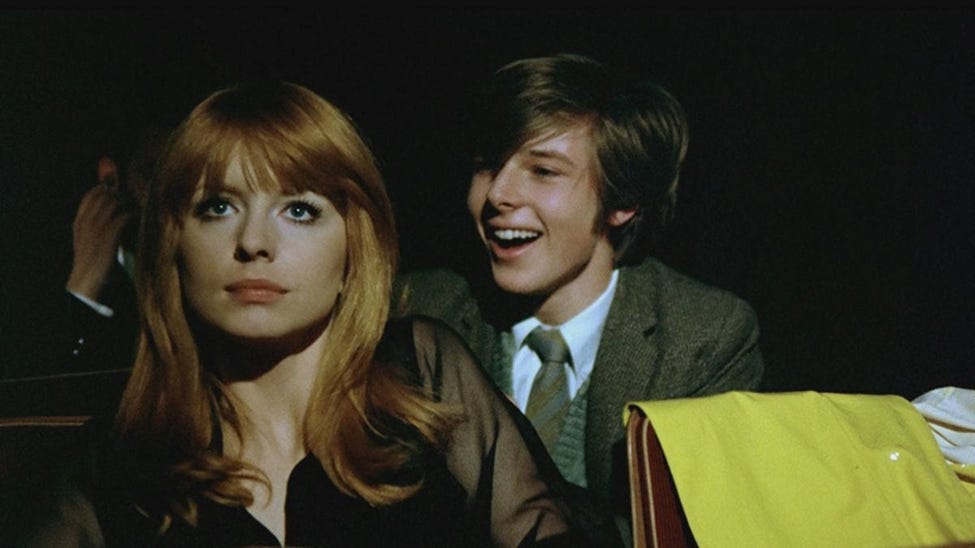
Asher’s Susan is another unstable element within the film. She’s a riveting character for how she alternately indulges Mike and rebuffs him, denying him clarity into who she really is and want she wants. She’s not characterized as a “tease,” which would be cheap, and she also doesn’t register as a mere object of desire. Through Skowlimowski’s playful sketching and Asher’s assured, endlessly absorbing performance, Susan comes off as a resilient young woman in conscious possession of her own knowability. She is also deeply sympathetic for how believably she copes with the various shitty men in her life. It doesn’t feel like much of a stretch to say the film belongs to her as much as it does to Mike.
The kineticism of the Skolimowski’s direction is reminiscent of Olivier Assayas at his best, particularly during a centerpiece sequence set to the Can song “Mother Sky,” which boasts an epic 14-minute runtime and was recorded specifically for Deep End. When Mike follows Susan and her fiancée to a members-only nightclub, he’s turned away and left to bum around outside, where he has a vaguely surreal series of encounters with a hot dog vendor, a prostitute with a broken leg, and a nude cardboard-cutout of Susan that he’s shocked to find outside a strip club. The song’s hypnotic guitars and the handheld camera movement capture the unruly intensity of being young, and make for an iconic display of filmmaking.